Monday morning, the van's full of tools, ladders, and offcuts heading to a job site. Friday night, the same van needs to be a place to actually sleep, somewhere off the Coromandel or up the Forgotten World Highway. For most owner-operators running an LCV in NZ, that's not a hypothetical, it's the actual weekly reality, and most bed setups force a choice between the two rather than supporting both.
Why a fixed bed setup doesn't work for a dual-purpose van
A permanent bed conversion solves the weekend problem and creates a new one Monday morning. Once it's built in, the cargo floor's gone for good, which is a real cost for anyone still using the van for trade work, deliveries, or hauling gear during the week. Ripping it back out to load a pallet or a ladder rack isn't a five-minute job, it's a weekend lost to undoing what took a weekend to build.
The second issue is fit. NZ campsites and forestry roads are rarely level, and a fixed bed with no adjustment just means waking up on a slope, or building in shims and packers that never quite sit right and rattle loose over rough roads anyway.
The third is that most build systems are single-purpose. A bed frame is a bed frame, full stop, it doesn't extend into a desk for working from the van, a mounting point for gear, or a partition system if the load changes from one job to the next. Every new need means another separate build.
The same tension plays out differently depending on who's driving. A sole trader needs the floor clear Monday morning. A family needs the same van to sleep two people Friday night, whether that's a parent and child or two adults parked off a Coromandel backroad. A fixed build doesn't stretch to cover both. The Omni-Frame does.
Where the BlackMOA Omni-Frame Modular Bed fits
This is built around the idea that the van shouldn't have to choose. The Omni-Frame system folds away to reclaim the full cargo floor for work, then locks back into place for sleeping, on a frame designed to adjust to whatever ground it's parked on, without needing tools or a rebuild every time the use case changes.
Features that matter for a NZ build
- Universal Omni-Frame compatibility — fits a wide range of LCVs via the spline mounting system, including Hiace, Transporter, Sprinter, Transit, Deliver 9, Crafter, and Master, so the system isn't locked to one vehicle if the fleet changes.
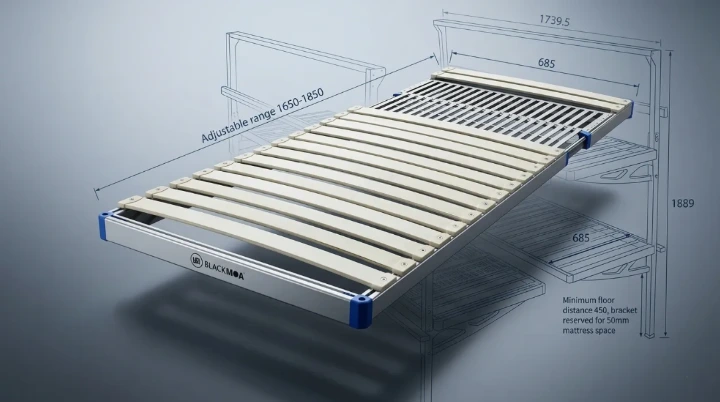
- 9° incremental angle adjustment — splined shaft joints lock the bed level on sloped or uneven ground, with zero play once set, so there's no shimming or packing required on uneven sites.
- Fold-away design — folds vertically against the wall racks when not in use, handing the full cargo floor back for work without disassembly.
- Modular growth — the same four-sided slot system extends to desks, hanging bag mounts, and tool partitions, so the frame isn't just a bed, it's the start of a wider fitout that can grow as the build's needs change.
- Lightweight aluminium construction — extruded aluminium profile, 15kg per bed (30kg for the pair), built for medium-to-light load use rather than heavy static fixtures.
- Supplied as a pair — two beds with frame included, adjustable from 1.65m to 1.85m in length and 0.685m wide, to suit a range of cab and body lengths.
Which vans this actually fits
The RV Bed | Foldable & Modular system's designed around the Omni-Frame spline, not a single body shape, so it covers a wider range than most fixed-bed kits. Large high-roof LCVs, Deliver 9, Sprinter, Transit, Crafter, and Master, are the primary fit thanks to their generous vertical space. Medium and lifestyle vans, Hiace, Transit Custom, Transporter, G10, and Vito, are also covered through the same universal slot connectors. Beyond standard vans, it suits overland 4x4 builds and mobile workshops just as well as a weekend camper conversion.
For anyone running one van across two completely different jobs, that's the difference between owning two setups and owning one that adapts.